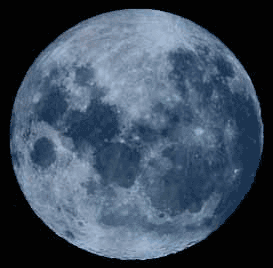
It
looks like there are actually THREE
contending definitions of Blue Moon!
-----
1) Modern definition: a second full moon
occurring in a calendar month.
Let's
call this the Calendar Blue Moon.
The more familiar definition is for a second full moon that occurs
in a calendar month. Because the lunar cycle is 29.5 days, a full
moon falling at the first of the month will be followed by a second
full moon within the same month (never in February, of course).
Given
variables involving time zone differences, this definition makes
it possible for the Blue Moon to appear in different months in
different parts of the world. That is what has happened this year.
There was a second full moon in the USA (EDT) on May 31, 2007,
at 9 p.m. In England (GDT), it was already 2 a.m. on June 1. So,
most western longitudes had their Blue Moon on May 31. For eastern
longitudes, the second full moon in the calendar month - their
Blue Moon - occurred on June 30.
This
definition only arose in the 1940s, apparently because of a misreading
of The Farmer's Almanac. It is keyed to the civil calendar and
really has no astrological significance.
-----
2)
Traditional definition: the third full moon in a seasonal quarter
having four full moons.
Let's
call this the Almanac Blue Moon.
There is a more traditional definition that relates the Blue Moon
to the seasonal quarters of the year, as marked by the equinoctial
and solstice points. Ordinarily, there are only three full moons
during a quarter year, one full moon for each of the quarter's
three zodiac signs. However, since the lunar cycle and solar cycle
are out of sync, a quarter of the year will sometimes have four
full moons instead of three. The old farmers' almanacs called
that extra full moon the "Blue Moon."
Interestingly,
in the old almanacs, it is the third full moon, not the fourth,
that is counted as the Blue Moon. Apparently, this is because
the last full moon of each quarter has a unique place in the regular
seasonal calendar (for instance, the Harvest Moon) and so can't
be regarded as "extra" or "Blue."
-----
3)
Astrological definition: the second full moon in one zodiac sign.
Let's
call it the Zodiac Blue Moon.
To my knowledge, traditional astrology doesn't use the term "Blue
Moon". It seems to have come into astrological language from folklore,
agricultural almanacs and popular parlance. But that doesn't mean
that we're aren't looking at an astrologically significant phenomenon.
We are! The almanac definition is right to see the importance
of having an extra full moon in a seasonal quarter of the year.
During most quarter years - counting, let's say, from the Spring
Equinox in Aries - there will be one full moon in each of the
three successive quarterly signs opposite the solar signs of the
season, for example in Libra (opposite Aries), Scorpio (opposite
Taurus), and Sagittarius (opposite Gemini). So if we have a fourth
full moon in a quarter year, this means that one of the three
seasonal zodiac signs will have two full moons instead of just
one. Astrologically, that second full moon in one zodiac sign
is the Blue Moon. It's like getting two shows for the price of
a single admission! Full moons powerfully "light up" and charge
issues connected with the zodiac signs in which they occur. During
a Zodiac Blue Moon, the full moon sign gets to deliver an extra
"zap" of energy. We'll feel it, so we need to pay attention and
plan!
The
next Zodiac Blue Moon - which also happens to be the Almanac Blue
Moon - will appear next year on May 19, 2008 at 29 Scorpio 27,
with the Sun on the other side of the Zodiac, at 29 Taurus 27.
For individuals, anyone born with the Sun or the Moon in either
Taurus or Scorpio will likely feel this Zodiac Blue Moon very
intensely; Cancerians, too, since they are always uniquely sensitive
to the Moon's activity. To see how the Blue Moon will affect world
events, we'd need to look very closely at what Scorpio is doing
in the seasonal solar ingress chart, which is set for the first
day of Spring, when the Sun enters Aries. We'd also want to look
at separate charts for each full moon.